
Inflating the Odds
A tractor-trailer lying on its side along I-80 is a serious obstacle, any way you look at it. There is literally and figuratively often no way around it. Especially when it ends up against an embankment or on uneven ground. Knock-on effects follow: traffic may be backed up, the trailer could be damaged, and recovery crews have to figure out how to get thousands of pounds of equipment upright without making matters worse. Sometimes, the best way to begin that heavy lift is with air rather than pulling force alone. For I-80 air cushion recovery, the first question is how to raise that equipment without concentrating too much force on one weakened area.
That’s where large inflatable recovery cushions can help. They provide a different way to begin lifting an overturned truck or trailer, particularly when pulling directly with a wrecker could put additional stress on the body.
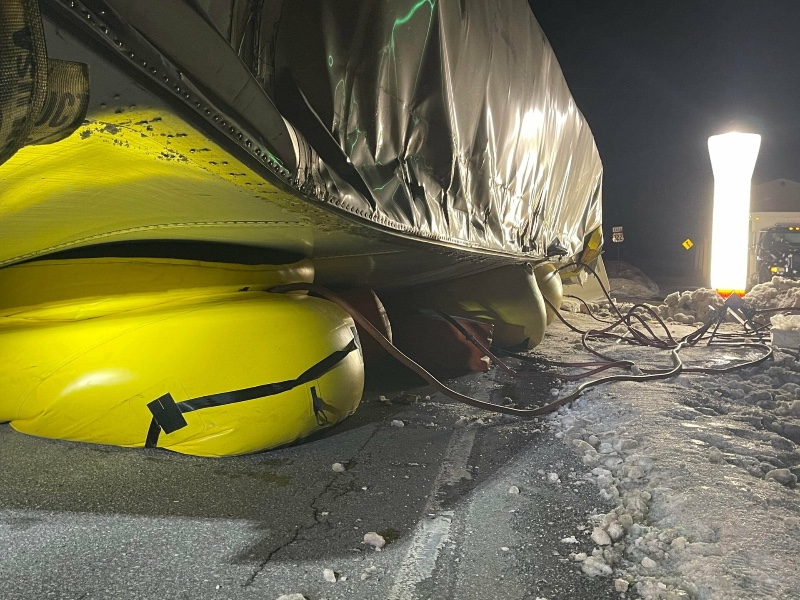
What Are Air Recovery Cushions?
An overturned vehicle does not always have a convenient lifting point. Air recovery cushions are large, heavy-duty inflatable bags placed beneath or alongside a truck or trailer to apply lifting force over a broader area. They aren’t ordinary shop airbags or the small jacks used to lift a passenger car.
As air enters the cushions, they expand and gradually raise the equipment. Because the force is spread across a wider contact area, the system can help limit pressure on vulnerable trailer panels. It doesn’t eliminate the risk of damage, though, and the load still needs to be controlled.
Air cushions don’t replace every other recovery tool, either. Winch lines, wreckers, and other rigging may be needed to keep the equipment from shifting as its center of gravity changes.
How an Air Cushion Recovery Works
Before anyone inflates a cushion, crews need to understand what they’re lifting. An empty box trailer behaves differently from one carrying heavy freight. A tanker, damaged chassis, or trailer resting on an embankment introduces other considerations.
The team assesses the load, the ground, the equipment’s condition, and where the cushions can be positioned. If cargo is unstable or hazardous, that issue may need attention before the lift.
A typical operation involves several steps:
- Assess the scene. Identify damage, cargo concerns, ground conditions, and available working space.
- Stabilize the equipment. Set up appropriate rigging and control lines before movement begins.
- Position the cushions. Place the bags where they can support the load without creating additional damage.
- Inflate in stages. Raise the overturned equipment gradually while monitoring its movement.
- Complete the upright. Use coordinated lifting or winching as needed to bring the equipment onto its wheels.
For air cushion recovery along I-80, the details vary from one incident to another. There’s no universal cushion placement or inflation sequence that works for every rollover.
Why Slow, Controlled Lifting Matters
During I-80 overturned truck recovery, the hardest moment may come as the trailer rises and its weight begins to transfer. The center of gravity moves, contact points change, and the equipment may start to roll more readily than it did at the beginning.
That’s why crews don’t simply inflate the bags and stand back. They monitor the lift and use control lines or recovery trucks to manage movement. A cushion supplies lifting force, but it doesn’t steer the load.
For heavy-duty air cushion recovery near I-80, having enough room to position the bags and other equipment is important. A narrow shoulder, slope, or unstable surface can change the entire setup.
Air Cushions Aren’t the Answer to Every Rollover
An I-80 air cushion recovery service may be useful when an overturned trailer would benefit from a broad, gradual lift. But badly damaged structures, shifting loads, and limited access can make another method more appropriate.
Even after a successful upright, the job isn’t necessarily finished. Crews still need to assess the tractor and trailer, clear the scene, and determine whether the equipment can be towed. The point of air cushion truck recovery on I-80 isn’t just to get a trailer standing again. It’s to control the movement as part of the larger recovery.
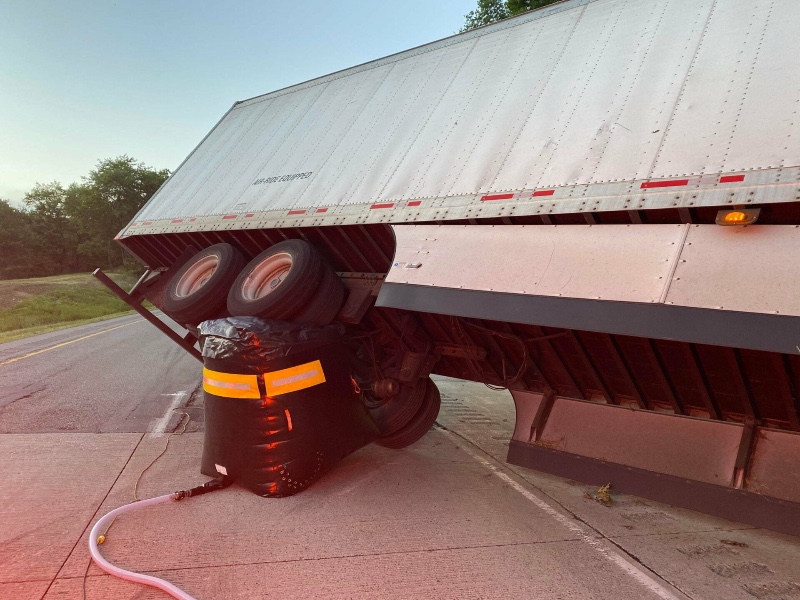
Bigler Boyz Towing: Your I-80 Air Cushion Recovery Experts
At Bigler Boyz, heavy-duty towing and recovery involves more than pulling disabled trucks off the road. Overturned tractor-trailers can require a different approach, and air cushion recovery offers a way to raise equipment while spreading the lifting force across a larger area.
Our heavy-duty recovery work focuses on assessing the equipment, determining an appropriate recovery method, and handling the towing or removal that may follow. Whether a truck needs a conventional heavy-duty tow or a more involved upright, we look at the condition of the equipment and the challenges at the scene before deciding how to proceed.
Frequently Asked Questions
What is air cushion recovery?
Air cushion recovery uses large inflatable bags to help lift overturned trucks, trailers, and other heavy equipment. The cushions expand gradually to apply lifting force over a broad area.
How are air cushions inflated during recovery?
Recovery cushions are inflated using a controlled compressed-air supply. Operators monitor the equipment’s movement and adjust the inflation as needed.
Are air cushions better than using a rotator?
Neither method is automatically better. Air cushions and rotators perform different functions, and crews may use them together depending on the rollover, trailer condition, and available space.
Can air cushions recover a loaded tractor-trailer?
They may be used in certain loaded-trailer recoveries, but cargo weight, stability, and distribution must be evaluated first. Some loads require unloading or other precautions before lifting begins.
Do air cushions prevent trailer damage?
They can help distribute lifting pressure and reduce stress concentrated in one area. However, they cannot guarantee that an already damaged trailer will avoid further damage.
What happens after an overturned truck is uprighted?
The crew assesses the truck and trailer for damage, clears recovery equipment, and determines whether towing or other transportation is necessary.