
Stay Seen & Stay Clear
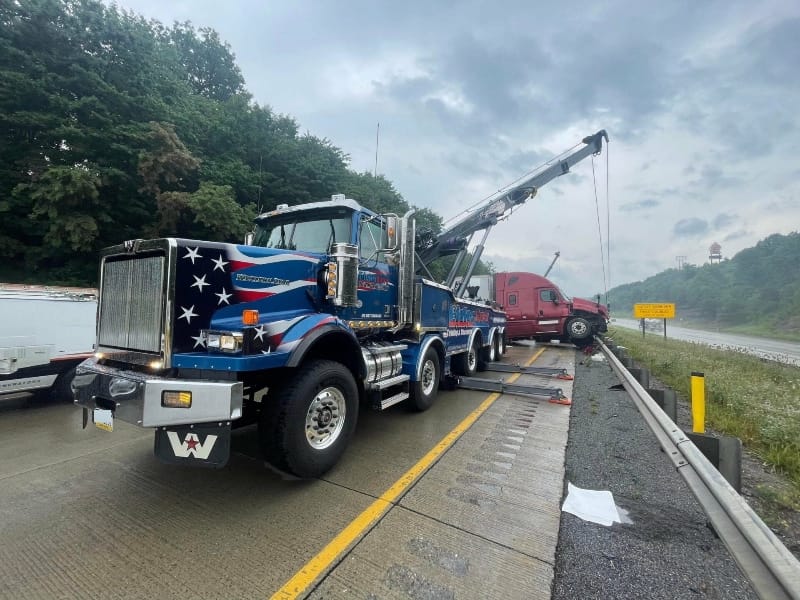
Interstate 80 carries some of the heaviest freight traffic in the country, and the trucks that make up that load run around the clock through all weather and conditions. Passenger vehicles share this corridor with 80,000-pound semis, and the gap in size, stopping distance, and visibility creates real risk when drivers do not understand how to navigate around them. As an I-80 towing company responding to highway incidents regularly, we see what happens when that gap is misjudged.
Semi-Safe
The incidents we work tell a consistent story. Semi truck drivers are professionals, trained and experienced in managing their vehicles on exactly these roads. The risk most often comes from the smaller vehicles around them. Drivers who treat a semi like any other vehicle on the road are working with incomplete information, and that gap shows up in the calls we receive.
The Physical Reality of Driving Near a Loaded Truck
A semi truck’s dimensions alone change what is safe at highway speed. The trailer extends up to 53 feet behind the cab, meaning blind spots exist on both sides and directly behind the trailer for 30 feet or more. In front of the cab, a close-range lead vehicle disappears entirely from the driver’s view. Changing lanes near the front of a semi without enough clearance, or lingering just behind the trailer at the edge of the driver’s mirror range, are positions that experienced drivers on the I-80 corridor know to avoid.
Stopping distances compound all of this. At highway speed, a fully loaded semi requires up to 40 percent more distance to stop than a standard passenger vehicle. That difference does not show up until a brake event happens, and by then the available distance is already determined. The space a driver maintains in front of and behind a semi is the only real control they have over that variable.
The Most Important Habit a Driver Can Build Around a Semi
Every car on I-80 shares the road with trucks moving at very similar speeds in very close proximity. The single most effective habit a driver can build is staying out of the no-zones: the areas directly beside the cab, behind the trailer, and in the tight space just in front of the truck. Staying visible in the truck driver’s mirrors is the foundation every other safety habit builds from.
A Practical Guide to Passing and Merging Near Semis
Safe behavior around semis comes down to a small set of consistent actions:
- Pass with intent: accelerate through the pass rather than pacing the truck alongside the trailer
- Signal early and clearly before any lane change near a semi
- Allow at least four seconds of clearance before merging in front of a truck
- Maintain longer following distances behind trailers than you would behind other vehicles
- Reduce speed in crosswinds: trailers shift and sway in wind conditions
- Extend every margin in rain, fog, or construction zones on the I-80 towing corridor
Our I-80 towing operators work these roads every day. The habits above are the ones that keep drivers out of the situations we respond to.
Bigler Boyz Towing: Your I-80 Towing Team When It Matters Most
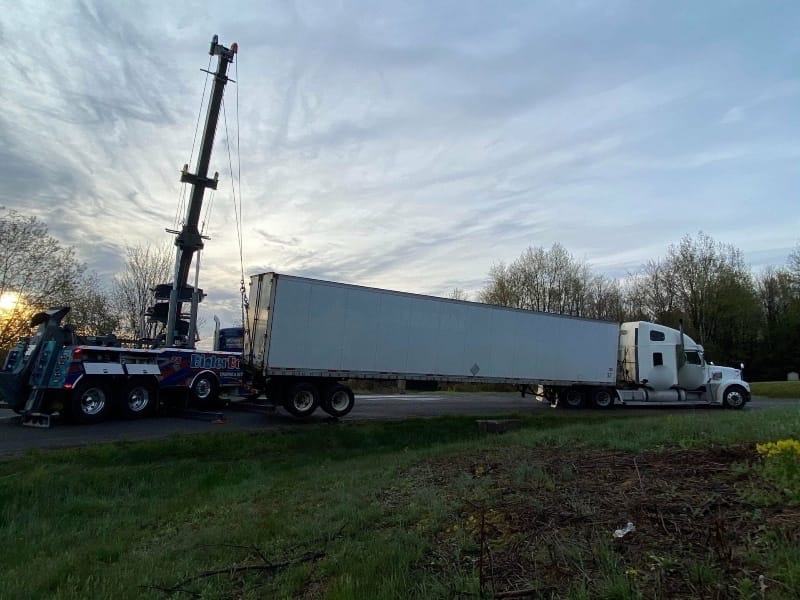
Bigler Boyz Towing is a recognized leader in the towing industry and a trusted name for I-80 towing across the region. Our fleet is equipped with current tools and technology, our operators are professionally trained and certified, and our in-house dispatch team is available around the clock.
We invest continuously in our fleet and in continuing education because the calls that come in on an I-80 towing corridor require current equipment and current training. From hazmat and spill remediation to full commercial recovery, every I-80 towing call receives the same standard: professionalism, safety, and five-star service on every dispatch.
FAQ
What should I do if my vehicle stalls in a lane near semi truck traffic?
Turn on hazard lights immediately and, if the vehicle has any movement at all, guide it to the nearest shoulder or exit. If it cannot move, stay inside with your seatbelt fastened until help arrives. Call for a tow and keep dispatch updated on your position, particularly if you are near a curve or hill where visibility is reduced for approaching drivers.
How do I safely pass a semi truck on the highway?
Move into the passing lane with clear intent and accelerate through the pass rather than gradually matching the truck’s speed. The goal is to clear the truck’s full length, including the trailer, as quickly as is safe given traffic conditions. Once past the front bumper with four seconds of clear space, you can move back into the right lane. Avoid lingering alongside the trailer at matching speeds.
What do truckers mean when they flash their lights at a passenger vehicle?
When a truck driver flashes headlights at a vehicle that just passed them, it is typically a signal that there is enough clearance to move back into the right lane. Passenger vehicle drivers can return the signal by briefly flashing their taillights to acknowledge. This communication is informal but widely practiced and helps make passing maneuvers smoother for both vehicles.
What are the most common mistakes drivers make near semi trucks?
The most frequent errors are cutting off a semi during a merge without adequate clearance, riding in the truck’s blind spots for extended periods, following too closely behind a trailer, and underestimating stopping distance when braking in front of a semi. Most of these errors involve the driver treating a semi as though it responds like a passenger car.
Is it safer to pass a semi or stay behind it?
Neither position is inherently safe if it means sitting in a blind spot. When following, maintain a gap that keeps the full back of the trailer visible rather than sitting close behind it. When passing, commit to the pass fully rather than pacing alongside the trailer. The safest positions are well ahead of the truck or well behind it with adequate following distance.
What should I do if a semi truck’s tire blows out near my vehicle?
Grip the steering wheel firmly and do not overcorrect if your vehicle is buffeted by debris or air displacement. Reduce speed gradually rather than braking hard. Move away from the truck as soon as it is safe to do so, keeping in mind that the truck driver may be managing their own vehicle through the blowout at the same time. Stay clear until the truck has regained stability.